
With so many changes in today’s cable ecosystem, vision camera and sensor systems are rapidly requiring better, more reliable data transmission. And many people are wanting more of it across longer distances at faster speeds. The manufacturing trends towards smart factories, increased use of robotics, and more machine vision applications, like machine vision cables, are driving this demand. Our clients demand more data, longer distances and greater reliability in a simplified design.
Current commodity cables fall short of keeping up with these advancements. They might be inexpensive, but they are typically limited to:
- Transmitting data across no more than 10 meters
- Have poor reliability
- Frequently fail in demanding environments
Multi-function cables combine copper and fiber with a USB-C connection to form a hybrid active optical data cable. This combination yields a streamlined solution with enhanced power delivery. It’s specifically designed and tested for rugged environments.
USB-C Active Optical Cables are durable, flexible, protect interconnect design from repetitive vibration. They also protect from EMI, and other environmental factors, and break through outdated limits with custom lengths of 50 meters or longer. These multi-function machine vision cables combine copper and fiber with a USB-C connection. This forms a hybrid active optical data cable designed and assessed for rugged, demanding environments.
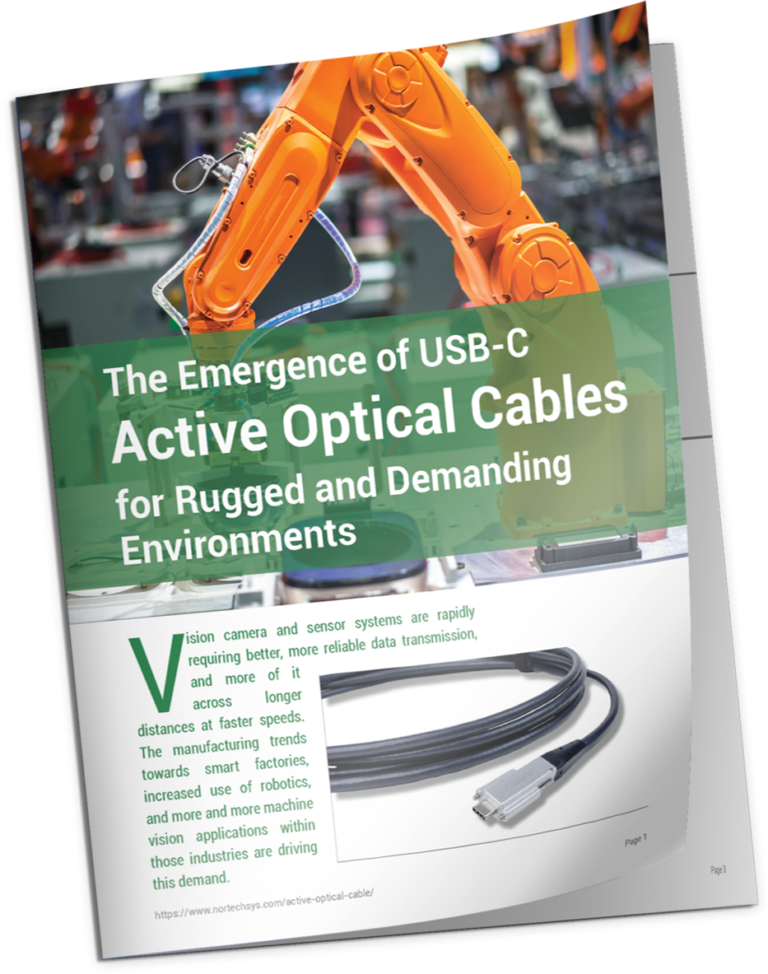
A variety of manufacturing industries use machine vision systems. In terms of application usage, our architecture is designed to be flexible, customizable and meet changing system configurations in many industries. For instance, Nortech’s USB-C Active Optical cables optimize machine vision in industries like automotive, semiconductor and electronics. In short, this means the same family of machine vision cables are valuable for many use cases.
Ease of use is a major consideration for the present technological landscape. There are no requirements for firmware at the component level or drivers at the system level. Plug and play is at the heart of the USB standard.
Additionally, the Type-C connector standard allows a user to plug in the cable using any orientation. This includes swapping end-for-end or flipping/rotating the connector-ends. By doing this, you can take the guess work out of how to plug in a cable. Active optical cables combine optic to electric transmitters and receivers in a bundled approach which secures future-facing technologies. As a result, active optical cables combine data (fiber optics) and power delivery (copper wires) in the same hybrid cable with added active components embedded within the connector ends.