

Table of Contents
As engineers evaluate alternatives to traditional copper-based power delivery, the biggest question is: how Power Over Fiber works?
While many discussions focus on the benefits, such as EMI immunity and electrical isolation, the true value of Power Over Fiber (PoF) is its underlying architecture. Understanding how energy is transmitted, converted, and delivered through optical fiber is critical for engineers. This helps them assess whether the technology is right for their application.
Our guide provides a technical overview of how Power Over Fiber works. You will also learn how it differs from conventional approaches and where it fits within modern system design.
What Is Power Over Fiber?
Power Over Fiber (PoF) is a technology that transmits electrical power through optical fiber by converting electricity into light. It then transports the light through fiber and converts it back into usable electrical energy at the receiving end.
For a full overview of benefits and use cases, see: Power Over Fiber: Solving EMI Challenges
What Is Power Over Fiber Used For?
Power Over Fiber is most commonly used when traditional electrical delivery creates performance or safety challenges.
Typical use cases include:
- EMI-sensitive environments (Ex. medical imaging)
- Systems requiring electrical isolation
- Remote or distributed components
- Harsh or high-voltage environments
These use cases are explored in more detail in a previous Power Over Fiber article, but the underlying reason is consistent: optical transmission solves problems that copper cannot.
Why Traditional Power Delivery Falls Short
Copper-based systems introduce several challenges that drive the need for Power Over Fiber:
- Electromagnetic interference (EMI)
- Ground loops
- Signal degradation over distance
- Weight and space constraints
Power Over Fiber removes the conductive path entirely. This eliminates many of these risks at the source rather than mitigating them through shielding or grounding.
Power Over Fiber vs. Copper Power Delivery
| Consideration | Copper-Based Power | Power Over Fiber |
| Power medium | Electrical current | Optical energy |
| EMI impact | Can introduce noise | Immune to EMI |
| Electrical isolation | Requires design mitigation | Inherent isolation |
| Weight | Heavier | Lighter |
| Distance limitations | Voltage drop over distance | Designed for remote delivery |
How Power Over Fiber Works (Step-by-Step)
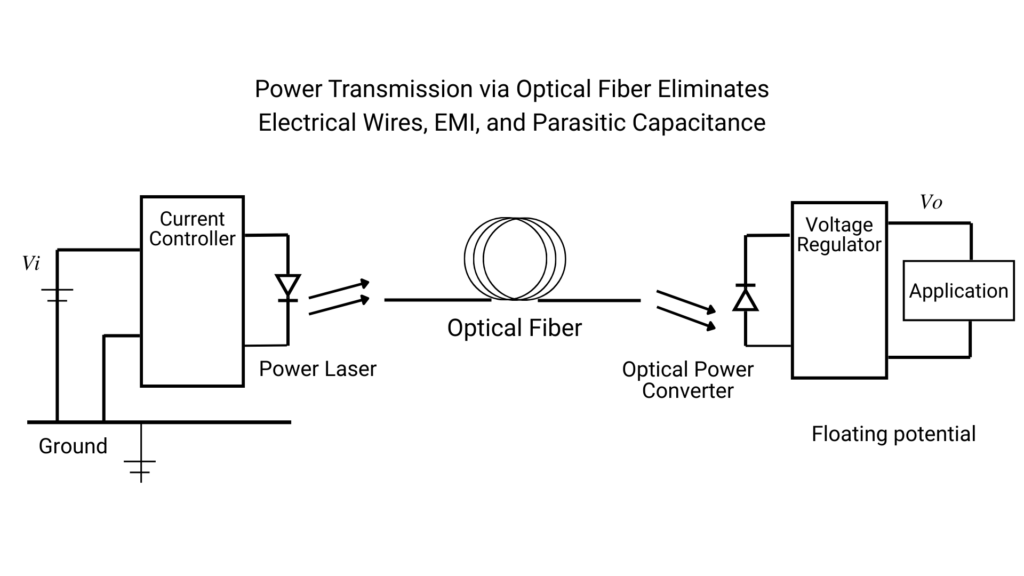
Understanding how Power Over Fiber works is easiest when viewed as a series of energy conversions. The core of Power Over Fiber is a three-stage system:
1. Electrical-to-Optical Conversion (Transmission Source)
Power begins as electrical energy at the source. Energy is converted into light using a laser or optical source. This step is fundamental because it enables power to be transmitted through a non-conductive medium.
Key considerations:
- Power level requirements
- Conversion efficiency
- Heat management at the source
2. Optical Transmission Through Fiber
Once converted into light, the energy travels through optical fiber to the destination.
Because fiber is non-conductive:
- There is no electromagnetic interference
- There are no ground loops
- Electrical isolation is inherent
This stage is where Power Over Fiber differs most significantly from copper-based systems.
3. Optical-to-Electrical Conversion (Receiver)
At the receiving end, the optical signal is converted back into electrical energy using a photovoltaic converted.
This enables:
- Power delivery to remote components
- Operation without a local electrical source
- Safe energy transfer in sensitive environments
4. System Integration & Output
The converted electrical output is then used to power devices such as:
- Sensors
- Cameras
- Controllers
- Embedded systems
This architecture enables designers to isolate, protect and simplify system-level power delivery.
Key System Design Considerations
Power Over Fiber is not simply a drop-in replacement for copper. It’s a system-level design decision. Explore the key considerations of fiber below to make the most informed decision for your next project.
Efficiency Trade-Offs
- Conversion from electrical → optical → electrical introduces losses
- Best suited for low-to-moderate power applications
Power Limits
Suitable for:
- Sensors
- Embedded systems
- Remote electronics
Optical fiber is not typically used for high-power applications.
Heat Management
Laser sources and conversion components require thermal consideration
System Architecture
Must be designed intentionally, not as a retrofit
For deeper technical reference, view: Nortech Power Over Fiber Overview (PDF)
Advantages of the Power Over Fiber Architecture
As Power Over Fiber technology continues to evolve, its use across industries continues to expand. While our June 1st article covers benefits in detail, the architecture directly enables:
- EMI immunity
- Electrical isolation
- Reduced system complexity
- Remote power delivery capabilities
These outcomes are not add-ons, and they are a direct result of how the system works.
Optical Fiber Application Examples
Below are some of the most ideal application examples for how to use Power Over Fiber. This technology is incredibly beneficial to many industries and applications. Explore the top use cases here.
Medical Systems
- Electrically isolated environments
- EMI-sensitive imaging systems
- Aerospace and Defense
- Lightweight systems
- Shielded and isolated components
Industrial Automation
- Remote sensors and cameras
- High-voltage environments
Subsea Systems
- Corrosion-resistant power delivery
- Long-distance remote deployment
When Should Engineers Use Power Over Fiber?
Power Over Fiber is not intended to replace conventional power distribution in every application. Instead, it delivers the greatest value in specialized environments where the traditional approach has challenges. Engineers should consider Power Over Fiber when:
-
EMI cannot be tolerated
-
Electrical isolation is required
-
Remote devices need power
-
Weight or space is constrained
-
Copper introduces unacceptable risk
Frequently Asked Questions
How does Power Over Fiber work?
Power Over Fiber converts electrical energy into light. Next, it transmits the light through fiber and converts it back into electrical power at the destination.
What makes Power Over Fiber different from copper?
Power Over Fiber uses optical transmission instead of electrical current. Because of this, EMI is eliminated which enables electrical isolation.
Is Power Over Fiber efficient?
Power Over Fiber introduces conversion losses but provides system-level advantages that outweigh inefficiencies in many applications.
What types of systems use Power Over Fiber?
Medical, aerospace, industrial and other EMI-sensitive or mission-critical systems.
Explore Nortech’s Power Over Fiber Solution
Optical fiber is not simply an alternative to copper. It represents a fundamentally different approach to power delivery.
By converting electrical energy into light and transmitting it through optical fiber, Power Over Fiber enables engineers to eliminate electromagnetic interference. As a result, you can achieve electrical isolation and deliver power to remote systems in ways that traditional approaches don’t support.
If you are evaluating next-generation system architectures, understanding how Power Over Fiber works is the first step toward determining when and where it creates the most value.
Learn how Nortech’s Power Over Fiber technology can optimize and support your next project now.